The Stalin era
English > Context > Historical and political > The Stalin era
1924
Vladimir Lenin died on January 21, 1924, the official cause of death being arteriosclerosis. On the morning of January 22, his body was mummified temporarily to be placed on a bier for several days in the Archway of the House of the Unions. But Joseph Stalin immediately showed that he counted as well: he wanted to prove that the bolsheviks could even overcome death. The Kremlin announced that Lenin's body would be preserved in a special mausoleum on the Red Square. And the name of Saint-Petersburg, the capital of the Romanovs, was changed into Leningrad.
End of January, a wooden mausoleum was set up. Behind closed doors many people were working to realise Stalin's plan. The anatomist Vladimir Vorobyov (1876-1937) and the young biochemic Boris Zbarsky (?-1952) mummified the body in such way that it could be preserved for a long time. When Zbarsky asked if the result of his work resembled to reality, Lenin's brother replied: «I can't say nothing, I'm just speechless. He looks like when I saw him just after his death.» And so Stalin offered a present to the first Congress without Lenin: he offered Lenin himself. Then he ordered the transformation of the wooden mausoleum to an impressive, monumental building, covered with dark red porphyry and black Labrador stones.
1926-1928
At the XVth Communist Party Congress in 1927, Leon Trotsky (1879-1940),Lev Borisovich Kamenev(1883-1936) and Grigory Yevseevich Zinoviev(1883-1936) were thrown out of the party and the New Economic Policy came to an end. Still in 1927, the jubilee year of the Cheka, dozens of engineers got arrested in the Donets basin, on suspicion of «sabotage». On May 20, 192,8 they were shown in Moscow - 53 engineers were brought up. It was an impressive show: all defendants chastised themselves plentifully. They seemed to want to compete with the public prosecutor on who could reveal the most serious accusations. The public prosecutor demanded death penalty against 23 defendants, but only 5 executions took place by way of thanks for their «good cooperation». Stalin ordered the labourers to search for saboteurs in all factories.
The first Five-Year Plan started on October 1, 1928. The emphasis was put on industrialization and collectivization of agriculture. The sovkhoz farms were presented as an example. A sovkhoz was a collective farm completely owned by the state. The machines were leased from leasing companies and the people working on the farms were on the payroll of the state. The word Совхоз was an abbreviation of Советское хозяйство [sovetskoe khozyaistvo] or soviet household.
On other collective farms, the kolkhoz farms, the farmers worked for a profit share, they were not working for the state nor someone else. The kolkhoz farms were property of groups of cooperating farmers, they had no guarantee for their income. The word колхоз was an abbreviation of the term коллективное хозяйство [kollektivnoe khozyaistvo] or collective household.
These independent farmers were called kulaks. Stalin started the forced collectivization of agriculture, and the «liquidation of the kulak class». The notion kulak appeared to be very flexible: millions of - often poor - farmers were deported to inhospitable places of the Soviet Union.
1929
Stalin urged the «collectivization without limits». The country was preparing its leader's 50th birthday, which was to be celebrated in December. He chose his own birthday as the ideal moment to start the Big Turn. Special freight trains, formerly used for the transportation of cattle, were now waiting for the transportation of people. Besides the kulaks, the old Russian villages had to be destroyed as well. The Revolution had offered land to the rural population. Now they had to return it, together with the cattle they had collected. Instead of «mine» they had to learn to say «ours» in the future. The kulaks, the farmers who had been doing relatively well until then, did not accept the new rules and were ready to resist. Therefore, Stalin decided to «solve» the problem in a revolutionary way by destroying them all. He appointed Vyacheslav Mikhailovich Molotov (1890-1986) as the head of the commission made responsible for it and Molotov did it in a diligent and bloody way.
In February, the kulaks were divided into groups. First, the so-called contra-revolutionary activists would be shot or sent to camps, and their families would be deported to the farthest corners of the country. After that, the most wealthy kulaks would be deported to far-away and unfruitful areas. They disappeared to the north, the Ural, Kazakhstan and Siberia. Nobody knew exactly who belonged to which category. The poor countrymen and the smallholders who escaped from deportation were united in collective state farms. The carefully kept livestock of the kulaks and their well kept farms were transferred into kolkhoz farms, together with all their other properties and savings.
April 1929 was the start of the biggest experiment of the 20th century, which would cause endless shedding of blood. In order to expose «saboteurs», Stalin would start using the secret police. It was also the start of the show trials. Right wing activists were put in the pillory all over the country, and found guilty in meetings organized in factories, training centers, kindergartens and even graveyards. From the beginning, the church was one of the targets of the bolshevik regime. Stalin demolished the churches literally, like Lenin wanted it. The climax of the campaign would be the destruction of the Cathedral of Christ the Saviour, Moscow's biggest church, in 1931. The churches which were not demolished were transformed into entrepots. School kids were ordered to take icons at school, in order to burn them in public. In exchange, they received posters with Lenin's image, to be put in place of the icons.
While the end of the decade was nearing, hordes of filthy and neglected people were wandering around and a great famine afflicted the country. Rural people had usurped the cities. The huge apartments of the rich became communal residences, in which lived ten or more families. The Catholic Pope Pius XI (1857-1939) incited the believers to pray for the persecuted christians in Russia. On the eve of the day on which this prayer would be announced worldwide, Stalin published a decree. He blamed the malicious overzealous party officials who had closed some churches contrary to the party rule. And, though the priests and the monks did not return from exile and 80 % of the country churches were still closed, the people reacted enthusiastically to the fact that on Stalin's orders a few churches had been re-opened. It successfully created a popular Russian character: «the good czar with the bad ministers» .
1930
In the summer of 1930, the intelligentsia were the next to be arrested by the secret police. In some scientific disciplines, 85% of the scientists was purged. Most were deported to Siberian or Asian labour camps or exiled. Some were executed by firing squads, or committed suicide when they were visited by the secret police. Many of them died in the Gulag.
A next show trial was organized, this time against so-called interventionists. The accused were members of the Industrial Party, mainly technically skilled intellectuals who were accused of preparing a push with the help of foreign governments.
1931-1932
At the beginning of the awful thirties, the avant-garde poet Vladimir Vladimirovich Mayakovsky (1893-1930) committed suicide by putting a bullit through his head. The avant-garde had wished a revolution in art, but the new regime wanted an art at the service of the revolution. Lenin had already created the Российская Ассоциация Пролетарских Писателей (RAPP) or the Russian Association of Proletarian Writers by which he wanted to counter the futurists. The RAPP was openly trying to put art under the control of the regime. When the association was abolished by Stalin in 1932 by decree, many writers were relieved, but the very same decree prohibited the existence of all other literary groupings. At the same time the Союз Советских Писателей [Soyuz Sovietskikh Pisateley] or the Union of Soviet Writers was created, presided by Maxim Gorky (1868-1936). As from 1934-1935, it would be almost impossible for non-members to get their works published.
In the winter of 1931-1932, the Ukraine, the Wolga area, the Caucasus and Kazakhstan were in the grip of the most important famine the country ever knew. Millions of starving people tried to take refuge in the cities, but there the bread was only supplied to inhabitants of the city having bread coupons. Nobody ever knew how many people died as a result of this famine. Estimations vary from 5 to 8 million. Stalin fought the famine with his usual weapon: terror. In August 1932, he drew up personally the notorious law stating that «individuals who misappropriate public funds must be considered as enemies of the people» and he proclamed cruel punishments for offenders of this law.
 Next page Stalin era
Share this page |
Political context
illustrations
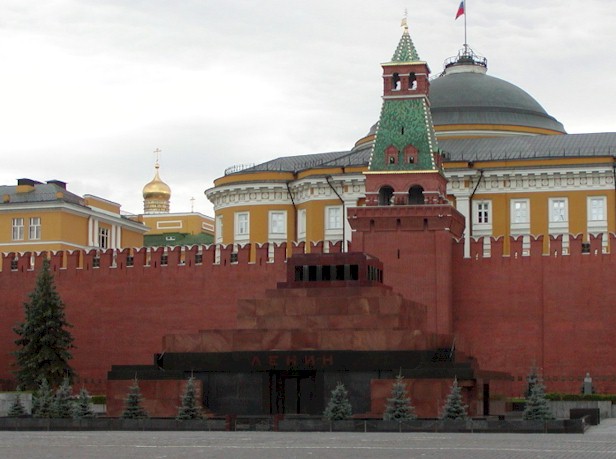
The Lenin Mausoleum
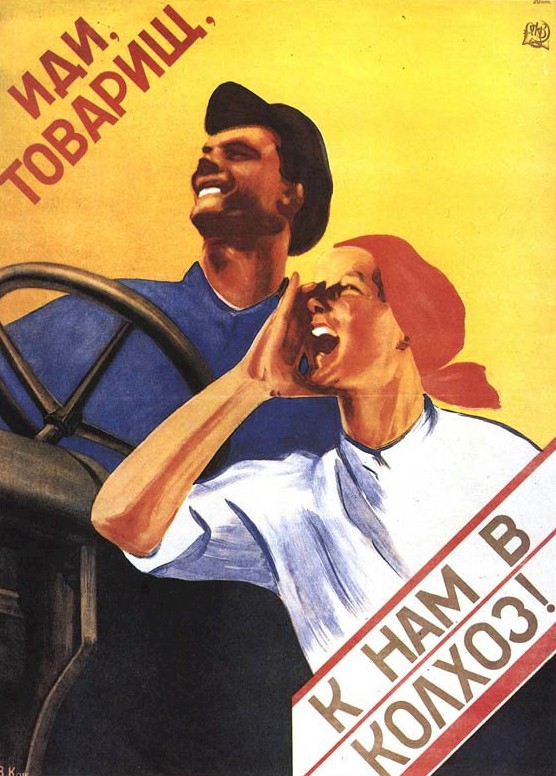
Come with us to the kolkhoze,
comrades!
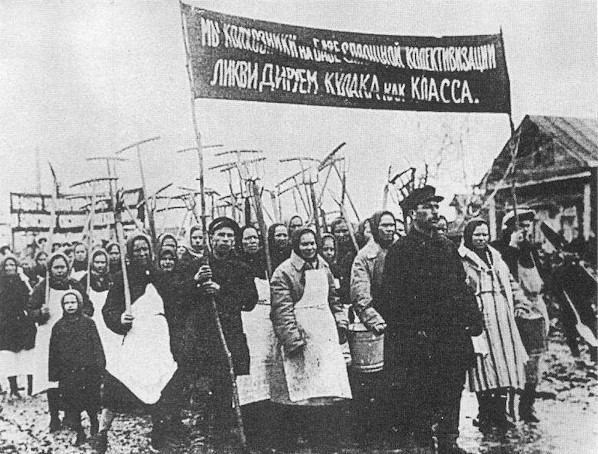
Farmers of the kolkhozes protest against
the kulaks in 1930
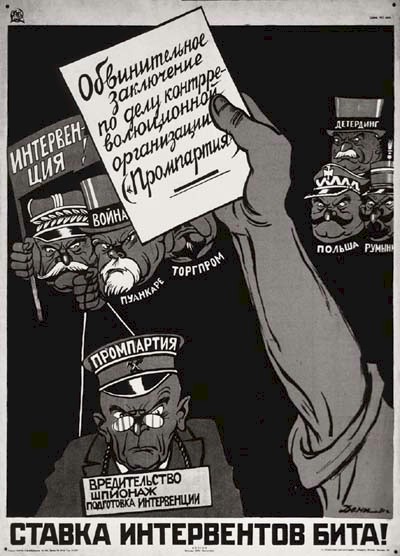
Poster against the interventionists in 1930