Русский и голландский
Русский > Контекст > Социальный контекст > Русский и голландский
In The Master and Margarita, Bulgakov occasionally used foreign words to increase the dramatic effect. In chapter 24, Behemoth used the German word Brüderschaft, and Koroviev regularly counts in German with eins, zwei, drei, or he uses the French avec plaisir to indicate that he would like to respond to a request. Doctor Stravinsky underlined his intellectual level with the Latin Sic transit gloria mundi, or And so passes the glory of the world, a phrase used by the master of ceremonies at the papal coronation in Catholic rites.
But regularly Bulgakov also used - perhaps unintentionally - Dutch words. Unwillingly, because it"s about words that the Russian language has taken from the Dutch, and which are part of the standard vocabulary of Russian.
In Chapter 5 of The Master and Margarita, at the Griboedov restaurant, Bulgakov introduces Bos'n George, a character inspired by the French female writer George Sand. The Russian name of the character is Штурман Жорж - in transliteration Shturman Zhorzh. To English speaking people it may not mean anything, but to Dutch speaking people, like me, it will sound very familiar. Shturman is pronounced almost exactly like the Dutch Stuurman and it has got exactly the same meaning.
It shouldn't be surprising, for there are quite some Russian words coming from Dutch. Especially in relation with shipping terms. That's because czar Peter the Great (1672-1725) was a few times in Holland and Belgium to get acquainted with the newest scientific developments in the shipbuilding industry. In 1697-1698 he was in Zaandam and Amsterdam (Holland), and his trip in 1717 was leading him to Liège, Nieuwpoort, Spa and Namur (Belgium). He also spent one day in Brussels, but you can read more about that below.
That's why the Russian language has now words like:
штурман [sjturman] - stuurman (steers man)
стул [stoel] - stoel (chair)
боцман [bootsman] - bootsman (boatswain)
матрос [matros] - matroos (sailor)
шкипер [shkipper] - schipper (skipper)
кабельтов [kabeltov] - kabeltouw (cable)
штевень [sjteven] - steven (bow)
ахтерштевень [achtersjteven] - achtersteven (stern)
брюки [brjoeki] - broek (pants)
юнкер [joenker] - jonker (squire)
шнур [sjnoer] - snoer (cord)
гастарбайтер [gastarbayter] - gastarbeider (foreign worker)
The words апельсин [appelsin] - appelsien or orange and персик [persik] - perzik or peach are also Dutch. Appelsien is a contraction of apple from China. The peach was originally from China as well, but this fruit was imported to Holland and Belgium through Persia, and derived its name from there.
The word рюкзак [ryukzak] - rugzak or rucksack, also of Dutch origin, is not only used by the Russians, but also by the English and the Germans. And ocasionnaly you can hear Russians say кошмар [koshmar] when something is tourning out badly. This is clearly coming from the French: кошмар [koshmar] is cauchemar or nightmare.
For reasons of completeness, we must admit that there are also some words in Dutch which have their origin in the Russian language. Like, for example, the word pierewaaien (go on the spree), which comes from пировать [pirovat'], which means partying. And mazout (heating oil) comes from мазут [mazut].
A memorable visit
On his second trip to the Low Countries, Peter the Great also paid a visit to Brussels, notably on April 16, 1717. This visit has made an unforgettable impression, because the traces of it can still be seen in the Royal Park opposite the Royal Palace. There's a bust of Peter the Great, next to a small walled waterpool. The bust was presented in 1854 by Prince Anatoly Demidov (1813-1870) to commemorate the results of an imperial drinking session.
On the edge of the pool is a Latin text: "Petrus Alexiowitz Czar Moscovitae, magnus dux, margini hujus fontis insidens, illius aquam nobilitavit libato vino hora post meridiem tertia die XVI aprilis anno 1717", or "Peter Aleksiovitz, Tsar of Moscow and Duke, sat on the edge of this fountain, where he has enriched the water with the wine he had been drinking on April 16, 1717, at three o'clock in the afternoon".
A good listener will immediately understand that the tsar had thrown up at this place after he had drunk too much red wine during a meal too generously doused.
Поместить эту страницу |
Социальный контекст
Illustrations
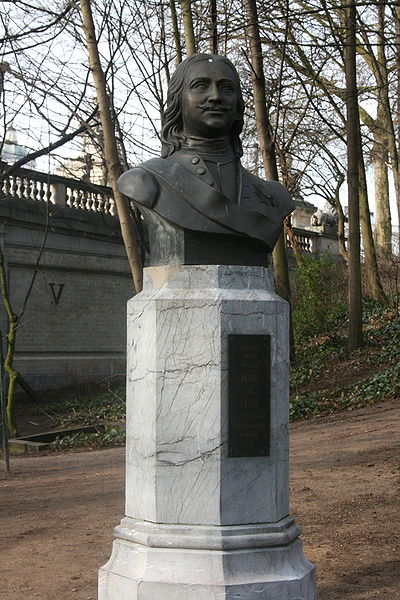
Bust of Peter the Great in Brussels