«Drones» on Valdai
English > Context > Political > Putinism > «Drones» on Valdai
The accusation
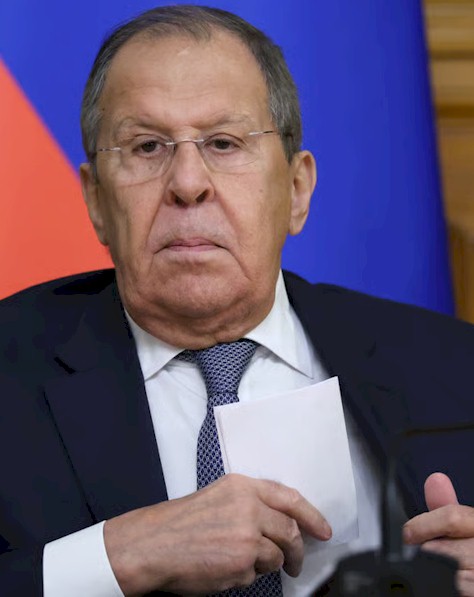
On Monday, December 29, 2025, at 7:20 a.m., the Russian Foreign Minister Sergei Viktorovich Lavrov announced that the Ukrainian military had attempted to eliminate Putin overnight by firing 91 long-range drones in the direction of Putin's residence in Novgorod Oblast, adding that all the drones had been shot down by Russian air defenses.
The Долгие Бороды [Dolgiye Borody] or Long Beards residence is a heavily guarded complex on the shores of Lake Valdai, approximately 360 km north of Moscow. It is one of three residences where Putin frequently spends time, and where one of three identical offices is located, which you can read more about by clicking on this link.
The luxurious estate is the primary residence of Putin's mistress, Alina Maratovna Kabaeva, a former Olympic and world champion in rhythmic gymnastics and now a member of the State Duma, who lives there with their two sons, Ivan (°2015) and Vladimir (°2019). In 2010 and 2011, it also served as a hideout for Putin's secret meetings with the then 17-year-old calendar girl, Alisa Vsevolodovna Kharsheva.

Lavrov said that the attack would cause Russia to «reconsider» its negotiating position in the ongoing talks about a possible end to the war. On December 30, 2025, Ukrainian President Volodymyr Zelensky dismissed the claims about the drone attacks on Putin's residence as fabrications. According to him, they were hastily concocted because he himself had had a positive meeting with US President Donald Trump on Sunday, December 28, 2025, in which, among other things, agreements were made about security guarantees for Ukraine after the war.
The «evidence»
Lavrov's announcement was immediately met with widespread disbelief and skepticism, at least in countries that supported Ukraine. However, it had an impact on Donald Trump. At a press conference following his meeting with Israeli Prime Minister Benjamin Netanyahu on December 29, Trump said that Putin had informed him of the news that morning and that it had made him «very angry». Nevertheless, the idea that it might be a fabrication prevailed in Western countries. Even the pro-Trump TV channel Fox News was critical, featuring the opinion of Cameron Chell, CEO and co-founder of the drone manufacturer Draganfly, which supplies the US Department of Defense and Ukraine. Chell confirmed that an attack of the type described by Putin and Lavrov could never have been carried out from a distance of 1,000 kilometers: «The cost-benefit analysis is also flawed, not to mention the political analysis».
In response to the apparently unexpected disbelief, a press conference was held two days after the alleged attack, on December 31, 2025, at the initiative of Major General Aleksander Vladimirovich Romanenkov, commander of the Russian Air Force's surface-to-air missile forces. Romanenkov wanted to present evidence that the Ukrainian army had indeed attempted to strike Putin. He showed a 35-second video and a map showing the alleged flight paths of the 91 drones.
But his «evidence», both the video and the map, was met with widespread skepticism around the world. Not many people saw it as «evidence» of a drone attack. Volodymir Zelensky even called it «ridiculous», which is quite accurate, as you can see for yourself:
But did not make Maria Vladimirobna Zakharova, the spokeswoman for the Russian Foreign Ministry, tone down the threats. On the contrary, she declared that the presented «evidence» provided sufficient grounds to declare: «Russia's response to the Ukrainian attack on President Vladimir Putin's residence will not be diplomatic»
Why it's not true
The skepticism surrounding Putin and Lavrov's «news» immediately prompted some experienced fact-checkers like the Institute for the Study of War (ISW), Meduza, and Reuters to dig deeper. They didn't have to dig very deep, because some obvious elements that could be determined with common sense pointed towards a staged story.
• When massive drone attacks occur in Russian regions, the Ministry of Defense is the first to report on them, followed by statements from local authorities, governors, and mayors, and messages in chat rooms and public groups of local residents who heard the explosions. Now, early in the morning, the Ministry's daily report suggested nothing unusual was happening. Only two hours later did Lavrov cause a stir.
• Drones launched from Ukraine's northern border would have to travel a distance of 1,000 kilometers through heavily guarded Russian airspace. Only a deliberate military omission by Russia could have made them succeed.
• It took almost a whole day for the Ministry of Defense's statements to be reconciled with those of Sergei Lavrov that morning. It is clear that no one - or certainly not everyone - at the ministry was aware of the fake news that was about to be spread.
• If the air defense had shot down 91 drones, there would have been a hellish racket all night long, which would certainly have been noticed by the residents; horses and dogs would have been dispersed, and game would have scattered in the woods… none of that happened.
• If the story had actually happened, the area and surrounding area would have been strewn with debris, which would have made for impressive footage, and drones would undoubtedly have exploded, either at the moment they were hit during their flight or when they hit the ground. Instead, we saw a video clip of barely 30 seconds showing one poorly damaged drone, and another was hit only in the tail section - that, «by chance» -, allowing for a clear view of the payload. The soldier's commentary was clearly rehearsed, though he wasn't a great actor.
• Zelensky is not stupid. On the very day he was first spared from being humiliated by Trump after a meeting, he certainly wouldn't risk anything that the man, who everyone knows how quickly he can change his mind, might turn against him again. And Putin isn't stupid either. He knows how to manipulate Trump, and was initially right when Trump said he was «very angry».
Better coordination required
As in several other notorious false flag operations orchestrated by the Kremlin or the FSB in the past, the initiators of this action encountered the consequences of a few oversights, further underscoring the operation's credibility.
Every morning, the Ministry of Defense proudly publishes a list of Ukrainian drones «intercepted and destroyed» by Russian air defenses last night on the very popular social network Telegram in Russia. This was also the case on the morning of December 29, 2025, when at 5:44 a.m. it was reported that 89 drones had been destroyed that night, 49 of them in the Bryansk region and 18 in the Novgorod region (where Putin's residence is located). These figures caused no stir, as they were not much different from any previous day.
At 7:20 a.m., Sergei Lavrov of the Ministry of Foreign Affairs suddenly announced his report about 91 drones, all aimed at Putin's residence. Perhaps there must have been some consultation between the two ministries afterward, because at 7:29 p.m., without further explanation, a message from the Ministry of Defense suddenly appeared on Telegram, reporting «91 drones, all deployed against the residence of the President of the Russian Federation in the Novgorod region». The message was accompanied by a map showing the alleged flight paths of the 91 drones, which now matches the map Major General Romanenkov had shown earlier that day.
Conclusion
A likely reason for unleashing this fake news is that Putin is well aware of the theory that Donald Trump is often influenced by the last person he spoke to, and that he was suspicious of Zelenskyy's personal visit to Mar-a-Lago on December 29, 2025, and what might be achieved during those talks. By accusing the Ukrainians of escalation to Trump, both publicly and by phone, Putin likely hoped to further influence the American president's assessment and avert decisions he perceived as too advantageous to Kyiv.
False flag operations
illustrations
Sergei Lavrov

Putin and Alina Kabaeva

Alisa Vsevolodovna Kharcheva

Cameron Chell

Aleksander Romanenkov

Putin and Maria Zakharova

Drones over Russia at 5:44

«Corrected» at 19:29