4. The Chase
English > The novel > Annotations per chapter > Chapter 4
Clickable map
On this website, you can find a clickable map on which you can follow Ivan's chase in the streets of Moscow.
Click here to follow Ivan's chase
The «A»-line
There are many streetcar lines in Moscow. They are all numbered, except for one which is indicated with the letter «A». This line, which is now called «Annushka», has one particular car which is called Трактиръ Аннушка [Traktir Annushka] or Café Annushka, and which serves as a restaurant. This line does not run along the Патриаршие пруды [Patriarshie Prudy] or Patriarch's Ponds, however, it runs laps around the Чистые пруды [Chistye Prudy] or Clean Ponds, 4 km to the east.
Click here to see the Café Annushka
Number 15, apartment 47
Ivan realizes that the professor must «unfailingly» be found in house number 15, and «most assuredly» in apartment 47. Here the translators made a little mistake, because in Bulgakov's original text is written number 13, apartment 47. Bulgakov actually describes the apartment of his friends the Lyamins. Nikolay Nikolaevich Lyamin (1892-1941), literary scholar and translator, and Natalia Abramovna Lyamina-Ushakova (1899-1990), his artist-wife. The address was slightly modified though, since in reality, the Lyamins lived at Savelievsky pereulok number 12, apartment 66.
The story of the Lyamins will come back later in the novel, in Nikanor Ivanovich's dream in chapter 15.
Primuses
«On the oven silently stood about a dozen extinguished primuses». The shortage of living space after the revolution led to the typical Soviet phenomenon of the communal apartments, in which several families would have one or two private rooms and share kitchen and toilet facilities. The primus stove, a portable one-burner stove fuelled with pressurized benzene, made its appearance at the same time and became a symbol of communal-apartment life. Each family would have its own primus.
The primus will play an important role further on in The Master and Margarita, when Koroviev and Behemoth bid Moscow farewell.
Two wedding candles
In the Orthodox marriage service, the bride and groom stand during the ceremony holding lighted candles. These are special, large, often decorated candles, and are customarily kept indefinitely after the wedding, sometimes in the corner with the family icon.
The Moscow River amphitheatre
The place «on the granite steps of the Moscow River amphitheatre», where Ivan dives swallow-fashion into the water, is at the foot of what had been the Cathedral of Christ the Saviour. «Had been», because in 1931, while Bulgakov was writing The Master and Margarita, the cathedral was dynamited by the Soviet regime. The remaining granite steps and amphitheatre were originally a grand baptismal font at the riverside, popularly known as the Jordan. The cathedral has now been rebuilt.
Click here to read the story of the cathedral
Having taken off his clothes
The incongruous bathing of Ivan can be assimilated with a christening. From this instant, Ivan is not the same person any more.
Getting rid of the clothes refers to the preparation for the initiation ritual in the first degree of Freemasonry, where the neophyte gets rid of his old outfit, including all metals such as watches, coins and rings. Symbolically he rids himself of his pride, his vanity, his greed and all that binds him to the material or the materialistic. It also means that he takes off the old man, with his accumulated knowledge, convictions, prejudices and passions and that he is open to a fundamental exploration of life and especially his own.
The interest of Bulgakov for Freemasonry can be explained by the fact that, in 1903, Afanasy Ivanovich Bulgakov (1859-1907), theologian and church historian, and the father of Mikhail Afanasievich, had written an article about Modern Freemasonry in its Relationship with the Church and the State, which was published in the Acts of the Theological Academy of Kyiv. Bulgakov refers more than once to Freemasonry in the novel.
Click here to read more on Freemasonry in The Master and Margarita
Yevgeny Onegin
Yevgeny Onegin is a great novel in verse written by Alexander Sergeevich Pushkin (1799-1837), wich inspired Pyotr Ilyich Tchaikovsky (1840-1893) to write an opera of the same name, of which the libretto is written by the composer's brother Modest Ilyich Tchaikovsky (1850-1916). Tatyana, mentioned further on, is the heroine of Yevgeny Onegin.
Yevgeny Onegin is a symbol of the classical Russian culture which Ivan and his fellows professionaly rejected. He is invited by this music to feel sorry for the hero of the opera, to find again what he had humiliated, and to reconcile with his roots. The polonaise comes from all the houses at the same time - they were equipped with radio's with one unique programme. With this description Bulgakov shows the standardization of culture in the Soviet society.
Click here to listen to «the hoarse roar» of the polonaise from the opera
A torn white Tolstoy blouse
A Tolstoy blouse or Tolstoy shirt is a traditional full Russian shirt with the collar opening on one side of the neck. The original name is косоворотка [kosovorotka] or skew-collared. It came to be associated with Lev Nikolaevich Tolstoy (1828-1910), who liked to dress in peasant costume and mow the meadow with his peasants. Hence the name тольстовка [tolstovka]. Since they were non-Western, such shirts were at various times signs of Russian nationalism.
The clothes which Ivan Bezdomny puts on to replace «the checkered cap, the cowboy shirt, the wrinkled white trousers and the black sneakers» that he wore at the Patriarch's Ponds, could refer to the initiation ritual for Apprentices, the first degree of Freemasonry, where the candidate is introduced in shabby clothes. Usually he wears, like Bezdomny, a torn, witish and half opened whitish shirt. The candidate is blindfolded. In the third version of The Master and Margarita from 1933, Ivan was temporarily blind when he was brought into the clinic.
The icon and the candle
During the initiation ritual for Apprentices in Freemasonry, the candidate is holding a candle, and the point of a sword is held on his chest. In an earlier version of The Master and Margarita, the paper icon was attached to Ivan's chest with a safety pin.
Share this page |
Chapters
- Introduction
- 1 Never Talk with Strangers
- 2 Pontius Pilate
- 3 The Seventh Proof
- 4 The Chase
- 5 There were Doings at Griboedov's
- 6 Schizophrenia, as was Said
- 7 A Naughty Apartment
- 8 The Combat between the Professor...
- 9 Koroviev's Stunts
- 10 News From Yalta
- 11 Ivan Splits in Two
- 12 Black Magic and Its Exposure
- 13 The Hero Enters
- 14 Glory to the Cock!
- 15 Nikanor Ivanovich's Dream
- 16 The Execution
- 17 An Unquiet Day
- 18 Hapless Visitors
- 19 Margarita
- 20 Azazello's Cream
- 21 Flight
- 22 By Candlelight
- 23 The Great Ball at Satan's
- 24 The Extraction of the Master
- 25 How the Procurator Tried...
- 26 The Burial
- 27 The End of Apartment No. 50
- 28 The Last Adventures of Koroviev...
- 29 The Fate of the Master and...
- 30 It's Time! It's Time!
- 31 On Sparrow Hills
- 32 Forgiveness and Eternal Refuge
- Epilogue
English subtitles

All films based on The Master and Margarita are subtitled in English, French, German, Dutch, Spanish and Italian.
Illustrations
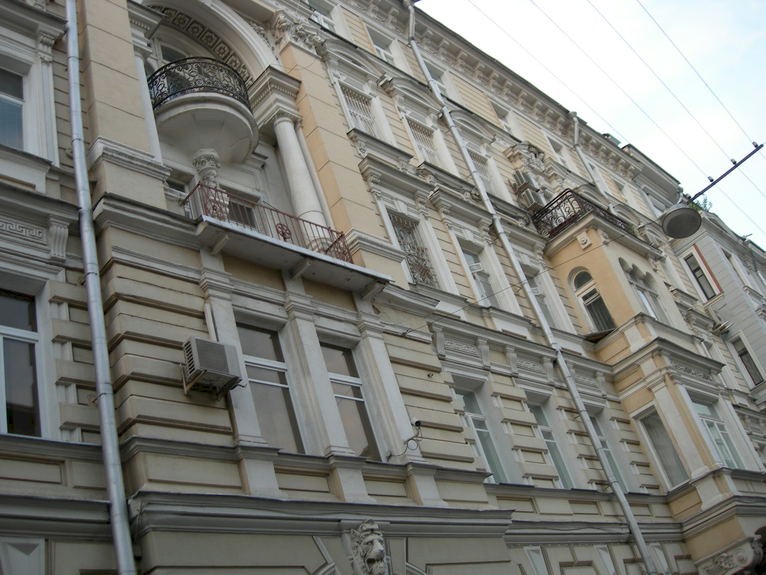
The house of the Liamins
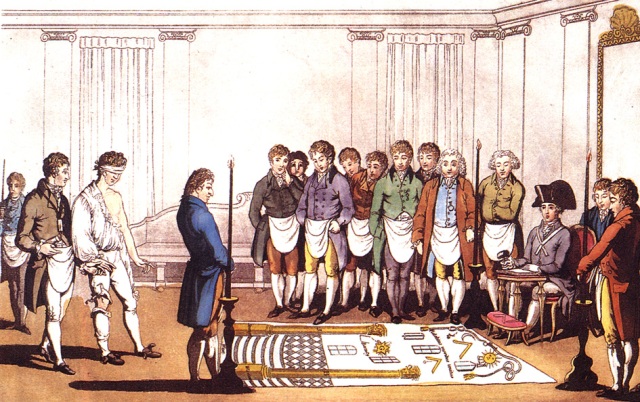
Initiation ritual in Freemasonry
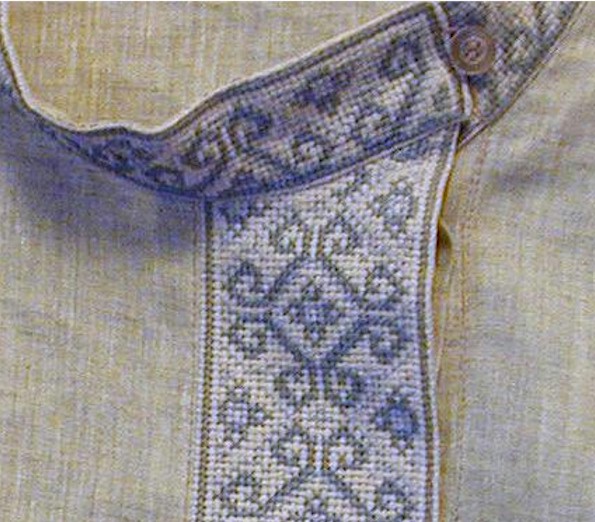
The collar of a tolstovka